

🇫🇷 France: 90 violent attacks on people in the crypto community. But don't worry—your data is "safe," after all 🙃🔐
In this article
Give us your name. Your address. Your financial information. Tell us that you own cryptocurrency. How much you have. Where you live.
Why?
Of course, for your safety. 😇
What if one day the database is compromised, someone sells the data, or criminals find out that a person who owns cryptocurrency lives at a specific address?
Well.
Apparently, we need even more regulations and an even bigger database. 🤡
Sounds like a joke?
In France, it's not funny anymore.
🔨 90 cases in just over seven months
According to data provided to Cointelegraph by the French Ministry of the Interior, from January 1 to mid-August 2026, French authorities recorded 90 cryptocurrency-related incidents, including kidnappings, extortion, threats, and violent robberies.
That works out to about one new case every 2.5 days.
Authorities also reported that 223 people were detained and 126 were sent to prison between January and July.
Welcome to France. 🥐🇫🇷
The land of cheese, wine, baguettes… and, apparently, an increasingly popular model:
"We know you have Bitcoin, and we know where you live."
Chainalysis also identifies France as a particularly significant hotspot for physical attacks on cryptocurrency owners. The company recorded 30 publicly known incidents by mid-2026, while noting that the actual scale was likely greater.
🗄️ The government wants to know everything. So do criminals.
And this is where the most interesting part of the whole story begins.
You have to be lucky to mug a random person.
To target a cryptocurrency owner with significant assets, it's better to have the right information.
Last name.
Address.
Phone number.
The fact that he owns cryptocurrencies.
Ideally, an estimate of his assets.
In other words, purely by chance, this is roughly the kind of data set that emerges when we create increasingly large, centralized systems for identifying and profiling citizens financially. 🎯
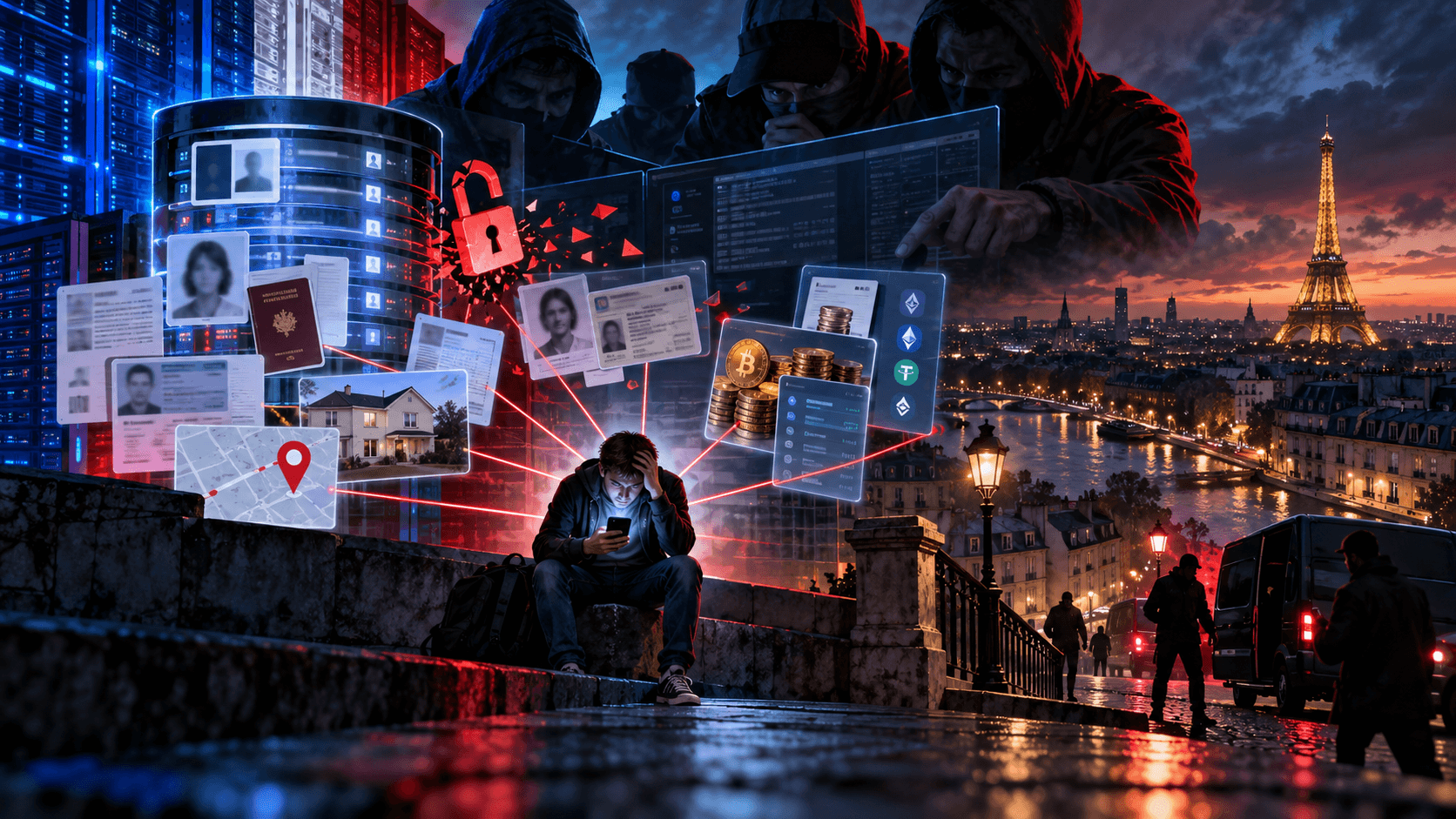
Chainalysis indicates that one of the most likely factors behind the wave of attacks in France was a major data breach. According to the company, in 2024, an official from the French tax administration allegedly stole and sold information about wealthy cryptocurrency holders—including, among other things , names, addresses, assets held, phone numbers, and tax data. The incident is presented as one of the possible factors that led to a sharp increase in the number of attacks.
Read that again.
The data collected in a system linked to the government was supposed to end up in the hands of people who could use it to create something like…
a list of potential targets.
But don't worry.
The problem is definitely that there isn't enough data. 🙃
🤡 “Know Your Customer” Meets “Know Your Victim”
Over the years, the cryptocurrency industry has explained:
"We need to know who you are."
For safety.
For compliance.
To combat crime.
For your own good.
Meanwhile, a physical criminal would also like to know who you are.
And he'll definitely be interested in the answers to a few additional questions:
Do you own any cryptocurrencies?
How much?
Where do you live?
Who are the members of your family?
According to Chainalysis, in France, more than 40% of the incidents analyzed involved relatives or acquaintances of the cryptocurrency owner, and not necessarily the wallet owner themselves. The company notes that this pattern suggests that the target was identified in advance—through social media, the blockchain, data leaks, or information obtained from individuals with access to such data.
That means you can perfectly secure your Ledger.
You can have your seed phrase engraved on a steel plate.
You can use multisig.
You should avoid clicking on suspicious links.
You may know all the cybersecurity rules.
And then someone will knock on the door with a wrench. 🔨
Cryptography protects the private key. It does not protect a person whose home address has ended up in someone else's database.
📧 And then another database appears…
In January 2026, Waltio, a French company specializing in cryptocurrency tax reporting, also revealed problems.
According to Waltio itself, the attackers gained access to, among other things , email addresses, information on profits or losses for 2024, and the balances of individual cryptocurrencies used for tax calculations.
The company emphasizes that, among other things, home addresses, private keys, wallet addresses, and identification documents were not compromised.
And that distinction is important.
Not every data breach automatically means that a criminal has obtained a Google Map with a pin on it:
📍 “A man with 37 BTC lives here.”
But it reveals something far more fundamental.
Every additional centralized data set is another target that can be attacked, copied, sold, or used for purposes other than those for which it was originally intended.
There's no need to hack Bitcoin.
Sometimes all it takes is to hack the database running alongside Bitcoin.
🔐 Privacy isn't a feature for criminals
In public debate, financial privacy is surprisingly often portrayed as if an honest person had nothing to hide.
That's an extremely convenient argument.
After all, I'm sure curtains at home are only installed by people involved in criminal activity. 😏
Phone password?
Suspicious.
An envelope for a letter?
A scandalous level of anonymity.
A bathroom door?
What is that citizen trying to hide there?! 🚨
Privacy is not a reward granted to a person by the government for good behavior.
It is one of the fundamental human rights. Article 12 of the Universal Declaration of Human Rights protects against arbitrary interference with one's private life, family, home, and correspondence.
And there's a very practical reason for that.
Information is power.
Therefore, the question should not be limited to:
"Do I have something to hide?"
A much more reasonable question is:
"What will happen to this information if it ever falls into the wrong hands?"
🏛️ “Trust us” is not a security model
This isn't about the absurd claim that every government official sits at their computer in the evening working on an Excel spreadsheet and sells the addresses of Bitcoin owners.
The problem is much simpler.
The government does not have any magical servers that are immune to hacking.
Government agencies hire people.
People make mistakes.
Systems have vulnerabilities.
Employees can be corrupted.
Passwords can be stolen.
Databases can be copied.
Subcontractors can be hacked.
And once data is leaked, you can't change your last name and home address as easily as you change your Gmail password.
Therefore, “trust the institution” should never replace the principle of data minimization.
It's not even a question of whether the government wants to protect your privacy.
The question is whether any institution should have a massive, centralized database that would make it possible to link:
👤 identity
💰 wealth
📱 Contact
🏠 place of residence
🪙 Holding cryptocurrencies
…if the consequences of a data breach could extend far beyond spam in your inbox.
🇫🇷 The most ironic lesson from France
The history of French crackdowns on cryptocurrency holders does not prove that every KYC system leads to extortion.
Nor does it prove that a single specific data breach is responsible for all the attacks in France.
Such a simplification would be unfair.
But it highlights something that regulators are particularly reluctant to highlight in capital letters in their PowerPoint presentations:
DATA COLLECTION IN ITSELF POSES A RISK.
The more information we gather in one place, the more valuable that place becomes.
This really isn't quantum cryptography.
That's basic risk math.
Create a database of 10 people — not very appealing.
Create a database of 10 million people containing information about their assets—congratulations. 🎉
You've just created something they'd really love:
hackers, fraudsters, blackmailers, corrupt employees, and organized crime groups.
🧠 Bitcoin reminds us of something the financial system has forgotten
Bitcoin was built around an idea that is very inconvenient for centralized institutions:
You don't have to trust something if you can verify it.
And perhaps the same principle should be applied to personal data.
No:
"Trust us—we're keeping a close eye on them."
Only:
"Why do you need to have them at all?"
Because the best database to hack is one that was never created.
The safest information about your assets is the kind that isn't held by ten institutions, seven intermediaries, and fifteen "trusted partners."
What about privacy?
It is not a gift from the government.
This promotion is not available through the end of the month.
Nor is it a privilege reserved for those who “have something to hide.”
🔐 Privacy is an essential part of human freedom.
And the French experience from 2026 gives us a very good reason to think twice before anyone says:
"Relax. Give us all your data. It'll be safe." 🙃