Help


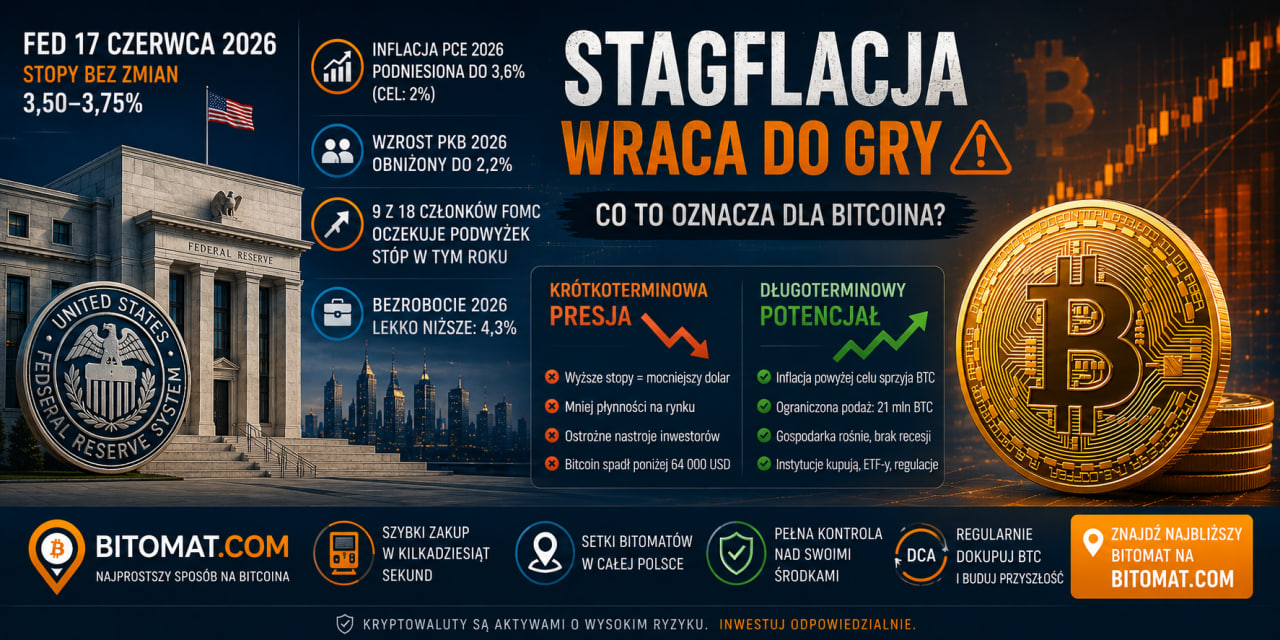
The U. S. Federal Reserve’s June meeting sent an important signal to financial markets. Although interest rates remained unchanged at 3.50–3.75%, investors focused primarily on the U. S. central bank’s more hawkish projections.
📈 The Fed raised its inflation forecast for the end of 2026 to 3.6%, well above its 2% target. At the same time, it lowered its economic growth forecast, and an increasing number of FOMC members are open to the possibility of further interest rate hikes later this year.
For the markets, this means one thing: the era of rapid interest rate cuts and cheap money may not arrive as quickly as was expected just a few months ago.
The combination of higher inflation and slower economic growth is a scenario known as stagflation. Historically, this has been a challenging environment for most financial assets.
📉 Higher interest rates increase companies’ financing costs, reduce market liquidity, and dampen investors’ risk appetite. It’s no surprise, then, that stocks and cryptocurrencies came under pressure following the Fed’s announcement.
Bitcoin fell below the $64,000 mark, and some investors began to fear further declines.
Does this mean that cryptocurrencies are in for a rough few months?
🤔 Not necessarily.
In the short term, there are several factors that could put pressure on the price of BTC:
Higher interest rates typically support the U. S. dollar. When the dollar strengthens, some investors reduce their exposure to riskier assets, including cryptocurrencies.
Historically, Bitcoin has benefited from periods of increased liquidity and accommodative monetary policy. When a central bank maintains tight financial conditions, the inflow of new capital into the crypto market often slows down.
The market continues to assess the Fed's future decisions. If inflation remains elevated and interest rates stay high longer than expected, investors may become more cautious.
Although Bitcoin often behaves similarly to technology companies, it has characteristics that set it apart from traditional assets.
There will never be more than 21 million bitcoins in circulation. This is a fundamental difference from fiat currencies, whose supply can be increased by central banks.
🛡️ In an environment of persistent inflation, investors are increasingly viewing Bitcoin as the digital equivalent of gold.
Despite the downward revision of economic growth forecasts, the U. S. economy is still growing at a rate of about 2.2%, and unemployment remains relatively low.
We are not currently facing a deep recession or a financial crisis that could trigger a complete flight from risky assets.
In recent years, the cryptocurrency market has undergone a massive transformation. Bitcoin ETFs, growing institutional adoption, and increasingly transparent regulations mean that interest in BTC is no longer limited to retail investors alone.
🚀 This is one of the reasons why many analysts remain optimistic about the long-term prospects of the world's largest cryptocurrency.
The answer depends primarily on your investment horizon.
If you're expecting rapid gains within a few weeks, keep in mind that increased volatility and the risk of further declines remain a real possibility.
⏳ On the other hand, investors who view Bitcoin from a 5-, 10-, or even 15-year perspective often use periods of uncertainty to gradually build their positions.
A popular strategy is DCA (Dollar Cost Averaging), which involves regularly buying small amounts regardless of the current price. This way, the investor doesn't have to try to guess the perfect time to enter the market.
Many people want to buy Bitcoin, but don't want to go through the complicated registration processes on foreign exchanges.
An alternative is Bitcoin ATMs, which allow you to quickly purchase cryptocurrencies with cash or a debit or credit card.
✅ Buy Bitcoin in as little as a few dozen seconds
✅ A network of Bitcoin ATMs throughout Poland and in many European countries
✅ Full control over your own funds
✅ The ability to regularly buy more BTC in accordance with the DCA strategy
✅ Intuitive operation, even for beginners
💡 For many people, this is one of the easiest ways to get started with Bitcoin or to steadily grow their holdings.
The future of the cryptocurrency market will largely depend on several key factors:
📌 upcoming U. S. inflation readings,
📌 labor market data,
📌 the Fed's interest rate decisions,
📌 the geopolitical situation affecting energy prices and inflation,
📌 Capital inflows into Bitcoin-based ETFs.
Each of these factors can influence short-term fluctuations in the BTC price.
The Fed’s June signals are not the most optimistic for risky markets. Higher inflation and the prospect of sustained high interest rates could trigger further volatility in the cryptocurrency market.
At the same time, Bitcoin remains an asset with a limited supply, which many investors view as a hedge against the long-term erosion of money's purchasing power.
🟠 That is why, instead of trying to predict the perfect time to buy, some market participants choose to build their positions gradually and consistently.
🏧 If you want to buy Bitcoin quickly and conveniently, find the nearest Bitcoin ATM Bitomat.com and see for yourself how easy it can be to get started in the world of cryptocurrencies.
⚠️ This article is for informational and educational purposes only. It does not constitute investment advice or a recommendation to buy or sell digital assets.