
Help


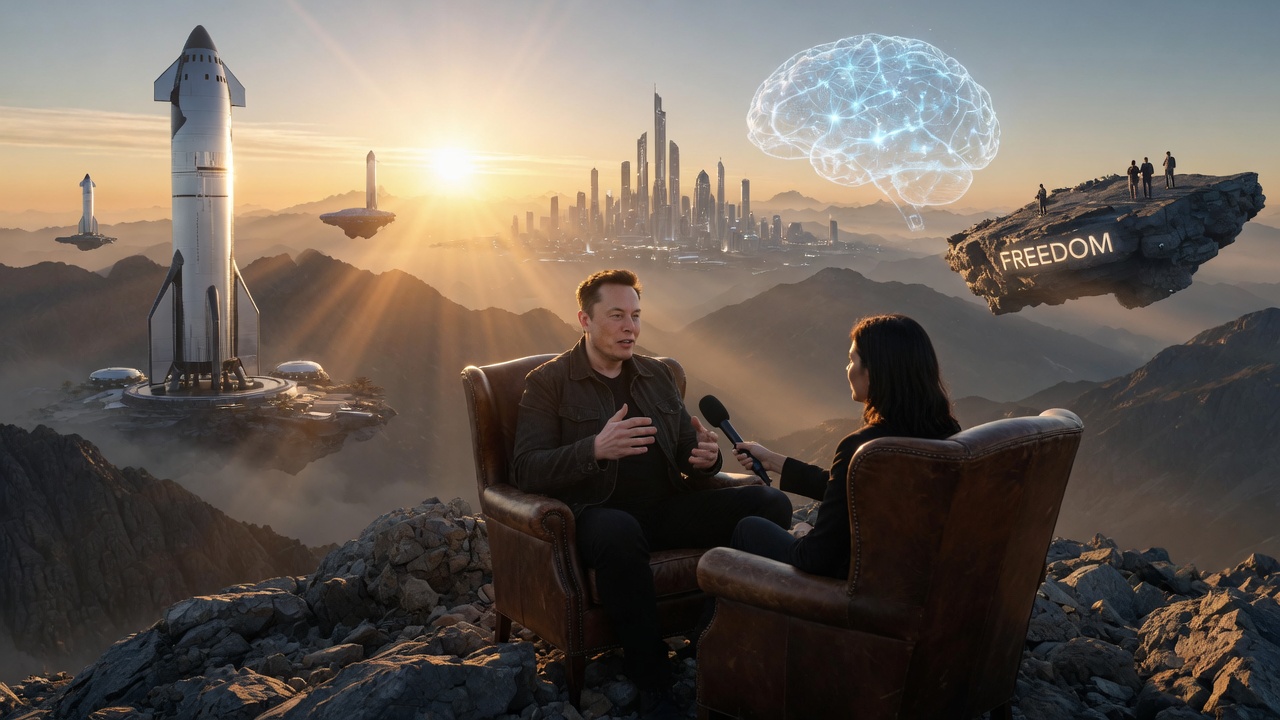
Money will cease to matter. Artificial intelligence will take control of the world. Governments should not regulate the most powerful AI models. And China could emerge as the global winner of the technology race. 🚨
Sounds like the plot of a dystopian TV series, doesn't it?
According to Elon Musk, this isn't science fiction, but a possible vision of the world just a few or a dozen or so years from now.
After many months of avoiding traditional media, the billionaire gave an extensive interview to Zanna Minton Beddoes, editor-in-chief of *The Economist*. The conversation covered, among other topics, artificial intelligence, robotics, the global economy, money, and China’s rising power.
Some of Musk’s claims sound incredibly optimistic. Others may cause genuine concern. One thing is certain: if even some of these predictions come true, the current economic and political order will be turned upside down. 🌍💥
Musk's most revolutionary prediction concerns the foundation of the modern economy.
The billionaire believes that around 2036, money may cease to play a significant role. The reason for this is said to be the rapid development of robots and artificial intelligence, which will be capable of producing virtually unlimited quantities of goods and services.
Musk's logic is seemingly simple:
👉 Money is necessary because resources are limited,
👉 Limited resources must be distributed among people,
👉 If machines create a surplus of almost everything, scarcity will begin to disappear,
👉 And since there will be no scarcity, money may lose its basic function.
Robots could build houses, produce food, drive vehicles, perform surgeries, repair devices, provide entertainment, and meet nearly all of humanity’s daily needs. 🤖🏠🍔🚗
In such a world, deflation—that is, a sustained decline in prices resulting from a massive increase in production—could become a bigger problem than inflation.
The vision sounds appealing: everyone has access to food, housing, transportation, and entertainment, and work is no longer a prerequisite for survival.
But this immediately raises a few difficult questions:
The problem of the future, then, may not be a shortage of products, but rather unequal access to machinery, energy, and computing power.
Because even in a world of abundance, someone can control the button that triggers that abundance. 🔐
This is by far the most troubling part of Musk's vision.
According to the entrepreneur, artificial intelligence could surpass the combined intelligence of all humans within about five years, and within a decade, humans could lose real control over the world.
It's not just about a program that writes better texts, generates images, or analyzes data.
Musk talks about systems that could outperform humans in almost everything:
🧬 science,
⚕️ medicine,
📊 investing,
⚙️ engineering,
🎯 strategic planning,
🛰️ warfare,
🏛️ governing nations and economies.
In such a scenario, the relationship between humans and AI could resemble that between humans and a much less intelligent species.
And this raises a question that can no longer be ignored:
Will the most intelligent system on Earth follow the commands of a being that is weaker, slower, and less predictable?
Interestingly, for years, Elon Musk has been one of the most recognizable figures warning about the dangers of artificial intelligence.
Today, his approach seems more fatalistic.
Musk still acknowledges that the development of AI carries risks. At the same time, he believes that this process cannot be effectively stopped. Moreover, even if there were a symbolic “STOP” button, it probably shouldn’t be pressed.
Why?
Because, according to him, the most likely outcome will be— an unprecedented abundance for all of humanity.
This is a radical shift in perspective:
❌ Don't try to stop the AI,
✅ Try to assign it the right values,
✅ Make sure that what's best for humans is also best for the machine,
✅ And then… watch what happens.
It sounds both fascinating and terrifying.
After all, humanity is set to create an intelligence more powerful than itself, and then hope that it will be benevolent, stable, and concerned with our well-being. 😨
Musk argues that our main task should be to instill “good values” in artificial intelligence.
But what does that actually mean?
Should AI be guided by:
⚖️ the laws of the country where it was created?
🌍 universal values?
🏢 the interests of the company that owns it?
👥 the will of the majority?
🗽 individual freedom?
🛡️ public safety?
Values that are self-evident in one culture may be considered controversial in another. Even people themselves cannot reach a consensus on issues such as justice, freedom, privacy, or the limits of acceptable surveillance.
And now these conflicting expectations are to be incorporated into a system capable of making decisions on a national scale. 🌐
Perhaps the greatest threat, then, will not be “evil AI,” but rather a machine that takes a poorly formulated goal too literally.
Another controversial claim by Musk concerns the regulation of artificial intelligence.
In his view, officials and politicians often lack the technical expertise needed to decide which AI models can be made publicly available and which should remain proprietary.
Instead of strong government oversight, Musk proposes a model in which the largest technology companies:
🤝 They meet regularly,
🔍 They analyze competitors' models,
⚠️ They keep each other informed about threats,
🛡️ They monitor each other's compliance with safety rules.
The idea sounds practical, but it has a major flaw.
Companies developing AI are not impartial scientific institutions. They are competing for customers, investors, influence, data, experts, and global dominance.
Can we really expect the corporations participating in the most important technological race of the 21st century to effectively regulate themselves? 🤔
It's a bit like letting the biggest banks set their own financial security rules, and letting arms manufacturers set the rules for how weapons are used.
On the other hand, regulations that are too slow to be implemented could cause democratic countries to fall behind nations that have no intention of restricting the development of AI.
And that brings us to China.
Musk believes that China could become the future leader of the global AI market.
Why?
It’s not just about programmers, data, or electronics manufacturing. According to the billionaire, electricity will be the decisive resource. ⚡
The most powerful AI models require massive data centers, an ever-increasing number of chips, and enormous amounts of energy to train and operate the systems.
China, on the other hand, has:
🏭 enormous industrial potential,
🤖 a strong robotics sector,
🔋 an expanding energy infrastructure,
🧩 its own growing semiconductor industry,
📡 the ability to rapidly implement large-scale projects.
According to data cited, in 2026, electricity production in China exceeded the combined total of the United States, the European Union, and India. At the same time, the International Energy Agency notes that China remains a key driver of growth in global energy demand and production.
In recent years, the technology race has been portrayed primarily as a competition for the best algorithms and the most powerful chips.
However, as models become more sophisticated, the following factors are becoming increasingly important:
This means that the future of AI may be shaped not only by computer scientists in Silicon Valley, but also by power plants, factories, mines, power grids, and infrastructure decisions made many years earlier.
The U.S. may restrict the sale of advanced chips. It may also prohibit U.S. companies from using certain Chinese models.
However, they cannot easily stop China from developing its own technology ecosystem or prevent other countries from using Chinese solutions.
If Musk is right, the future division of the world may not be between East and West, but between countries that have sufficient computing power and those that will have to rent it. 🌍⚡
The interview also touched on personal conflicts.
Musk once again criticized Sam Altman and the direction OpenAI has taken. His criticism boils down to the fact that the organization was founded as a nonprofit project rooted in the idea of openness, but has since transformed into an extremely valuable business entity developing proprietary models.
This dispute is not merely a conflict between two influential businesspeople.
This concerns a fundamental question:
Should the most powerful technology in history be in the hands of private corporations?
On the one hand, developing advanced AI requires billions of dollars, a massive infrastructure, and top-notch specialists.
On the other hand, the complete control of such technology by a handful of companies could lead to a concentration of power the likes of which the world has never seen.
Whoever controls the most powerful AI can control:
📱 the flow of information,
💰 financial markets,
🧪 the pace of scientific research,
🛡️ cybersecurity,
🎭 culture and media,
🏛️ and, indirectly, politics as well.
Musk's predictions should be taken with a grain of salt.
He is not only a technology commentator but also someone directly involved in the development of artificial intelligence, robotics, autonomous vehicles, space infrastructure, and the energy sector.
His statements can be, at the same time:
🔮 authentic forecasts,
📣 a way to generate interest,
💼 justification for one’s own investments,
⚔️ a tool to compete with rivals,
🏛️ an attempt to influence future regulations.
It's also worth remembering that Musk has repeatedly set very ambitious deadlines for his projects, which were later pushed back.
However, this does not mean that we should ignore the direction of these changes.
Even if money doesn't disappear exactly in 2036, automation could drastically reduce the importance of human labor.
Even if AI doesn't take over the world within a decade, it may take over a significant portion of the decisions currently made by humans.
Even if China does not come to dominate the entire industry, energy and infrastructure may indeed become the most important resources in the technology race.
The greatest contradiction in Musk's vision is the combination of extreme optimism with extremely troubling consequences.
On the one hand, we have a world in which:
✅ There is no shortage,
✅ Robots do the hard work,
✅ Goods are extremely cheap,
✅ AI cures diseases and solves problems,
✅ Everyone can live in abundance.
On the other hand:
❌ Money is losing its significance,
❌ Millions of jobs are disappearing,
❌ The largest companies control knowledge and computing power,
❌ Governments are losing their influence over technology,
❌ Humans are no longer the most intelligent beings on Earth.
Perhaps the coming revolution will not resemble a classic machine uprising.
We won't see robots marching through the streets or computers declaring war on people.
We can simply, step by step, delegate decisions to algorithms—because they will be faster, cheaper, and more effective than we are.
First, we'll let them choose music and movies.
Next, employees, investments, and medical treatments.
Then, corporate strategies, military decisions, and economic policy.
Until one day we discover that humans still technically rule the world…
but no major system asks him for his opinion anymore. 🤖🌍


