

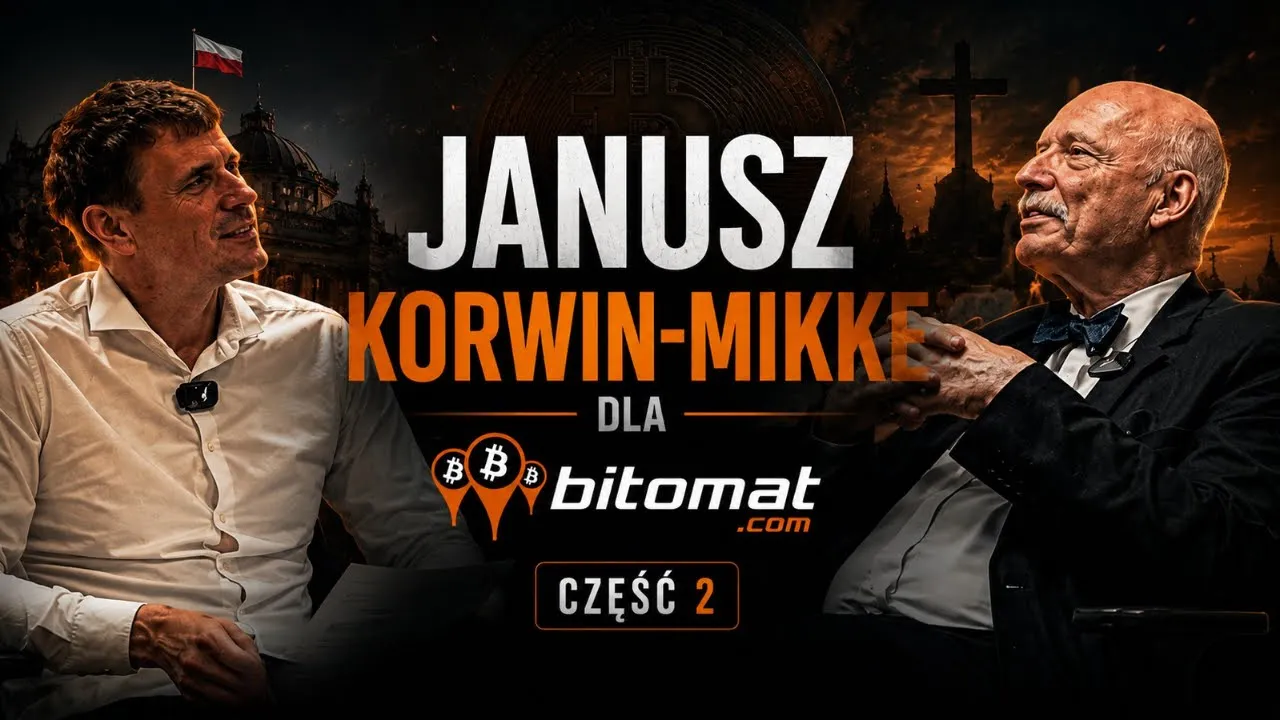
🎙️ Janusz Korwin-Mikke on power, culture, the West, and the war in Ukraine. A conversation full of controversy💥
In this article
Power, titles, and respect for office 👑
In the interview, Janusz Korwin-Mikke reverts to one of his characteristic ways of speaking: addressing people with whom he often fundamentally disagrees by their official titles.
He emphasizes that the title is not an expression of personal respect for the individual, but rather refers to the position that person holds. Therefore, as he explains, one can address someone as “His Excellency” while at the same time sharply criticizing their views or decisions.
The title belongs to the position, not to the person
Korwin-Mikke points out that respect for titles stems from recognition of the existing formal order. Even if he does not agree with the democratic method of electing leaders, he acknowledges that the person holding actual power does indeed possess it.
The main point:
he is not interested in the mechanism of electing leaders, but in the fact that a given person actually exercises power.
This distinction between a personal assessment of a person and recognition of the formal position they hold is typical of his way of thinking.
Music Then and Now: Nostalgia for a Melody 🎶
After the political introduction, the conversation shifts to a lighter but very distinctive topic: music.
Korwin-Mikke admits that he enjoys listening to music, but above all, he likes music that has melody, substance, and a certain elegance. He mentions Mozart, light classical music, and old French, Italian, and Spanish songs.
A Critique of Contemporary Pop Culture
In his view, today’s popular music is often too simplistic and reduced to rhythmic noise. He characteristically describes contemporary music as mostly “blah-blah” to him.
At the same time, he doesn’t reject all popular music. He mentions that he used to listen to rock bands and could appreciate songs that “said something about the world.”
Old Europe vs. the Dominance of American Culture 🌍
An interesting point comes up when discussing songs from the 1950s. Korwin-Mikke notes that French, Italian, and Spanish tunes once dominated the European music scene, while American music did not yet hold such a strong position.
In his view, American culture has come to dominate the world—and it’s not a change he likes.
The War in Ukraine: Geopolitics Trumps Emotions ⚔️
The most controversial part of the conversation concerns the war in Ukraine and Poland’s role in that conflict.
Korwin-Mikke consistently emphasizes that, in his view, Poland should not be guided by emotions or sympathy for either side, but solely by its own national interest.
“The Polish Interest” as a starting point
In his view, the question is not who is good and who is bad. The question is: what is in Poland’s best interest?
This approach completely subordinates political morality to the logic of geopolitics. Korwin-Mikke suggests that states should act as great powers do—coolly, pragmatically, and without sentiment.
Private morality versus public morality
The interviewer tries to challenge him with the question: if, in private, a person helps someone who is being harmed, shouldn’t a similar principle apply to states?
Korwin-Mikke responds that these are two different spheres.
In one’s private life, one can be guided by personal morality, but in politics—according to him—the interests of the state are paramount.
This is one of the strongest points made in the conversation:
a politician should not be guided by personal feelings, but by the interests of the country.
Russia, the West, and the Clash of Civilizations 🏛️
The conversation also touches on a very broad theme related to civilization. Korwin-Mikke states that he considers himself a man of the West, but at the same time claims that modern Western Europe has strayed from the traditional foundations of European civilization.
A Critique of the Modern West
According to him, the West has lost the traditional elements of its identity: monarchy, hierarchy, traditional social roles, and the conservative order.
In this context, he portrays Russia not as an ideal state, but as a country that—in his view—is trying to preserve what remains of the former European civilization.
This is, of course, one of the most controversial parts of the conversation, especially since it contains strong comparisons and harsh assessments of contemporary Western culture.
Russia is far from perfect, but strategically important
Korwin-Mikke acknowledges that disturbing changes are taking place in Russia. He points to restrictions on freedom, repression, Soviet symbolism, and a return to certain elements of imperialist thinking.
At the same time, he distinguishes between his assessment of Russia as a country and the question of Poland’s interests.
His position can be summarized as follows:
Russia may be a problematic country, but in geopolitics, what matters is whether its existence and actions can serve as a counterweight to other powers.
Ukraine: Between East and West 🇺🇦
The interviewer is trying to determine whether, since Korwin-Mikke criticizes the modern West, he believes that Ukraine would be better off under Russian influence than under Western influence.
Korwin-Mikke’s response is ambiguous but consistent in its logic: he is not concerned with Ukraine’s welfare, but with Poland’s interests.
Not on Russia's side, but on Poland's side
Importantly, Korwin-Mikke does not say that Poland should side with Russia. On the contrary—he emphasizes that Poland should not take sides for ideological reasons.
For him, the most important thing is that Poland not be drawn into a conflict that does not serve its immediate interests.
NATO, Ukraine, and the Logic of Great Powers 🌐
The conversation also touches on the topic of NATO. Korwin-Mikke compares Ukraine’s situation to a hypothetical scenario in which Mexico would enter into a military alliance with Russia and purchase missiles from it capable of reaching American cities.
According to him, the United States would not accept such a scenario—and similarly, Russia does not accept Ukraine’s rapprochement with NATO.
The right of great powers to a security zone
This line of reasoning leads him to the conclusion that great powers always defend their own spheres of influence.
You may or may not agree with this argument, but it is clear from the interview that Korwin-Mikke views the world through the lens of realpolitik—that is, brutal, self-serving power politics.
Freedom of Speech, Censorship, and the West Under the Microscope 🗣️
Another important issue is freedom of speech. Korwin-Mikke criticizes the West for political correctness, restrictions on public debate, and situations in which—in his view—people lose their jobs or are punished for expressing unpopular opinions.
The West, which fears its own questions
The conversation includes examples related to universities, scientific research, the media, and the boundaries of public debate.
Korwin-Mikke portrays the modern West as a place that pays lip service to freedom but, in practice, increasingly restricts freedom of speech.
The central argument of this passage:
freedom of speech is not about protecting popular opinions, but those that provoke opposition.
Conservatism, family, and content moderation 👨👧
The conversation also touches on a personal topic related to family. Korwin-Mikke says that, as a father, he is beginning to view issues of censorship, the internet, and children’s access to content in a different light.
This leads him to the provocative idea that, when it comes to women and children, the rules of free speech should be treated differently than they are for adult men.
This is another passage that may stir up strong emotions, but it clearly illustrates the consistency of his conservative outlook: for him, freedom is not an absolute value in every context.
A conversation full of tension and contradictions 🔥
The entire conversation is very fast-paced, as the host repeatedly tries to confront Korwin-Mikke with the consequences of his views.
On the one hand, Korwin-Mikke professes his attachment to Western civilization.
On the other hand, he sharply criticizes the modern West.
On the one hand, it speaks of freedom.
On the other hand, it allows for restrictions in certain situations.
On the one hand, he rejects moralizing in politics.
On the other hand, he himself makes very strong judgments about civilization.
It is precisely these tensions that make the conversation so vivid.
Summary: Cool-headed geopolitics versus public sentiment 🧭
This interview showcases Janusz Korwin-Mikke in his characteristic style: provocative, uncompromising, and full of references to history and civilization.
The main themes are:
- respect for the office, but not necessarily for the person,
- nostalgia for the European culture of the past,
- criticism of the modern West,
- a geopolitical approach to the war in Ukraine,
- the belief that Poland should be guided solely by its own interests,
- a strong stance against modern-day freedom of speech and political correctness.
Whether you agree with Korwin-Mikk or find his views highly controversial, one thing is certain: this interview will not leave the reader indifferent.
This is no ordinary exchange of views.
It is a clash between two worldviews:
a moral and emotional one on the one hand, and cold, geopolitical realism on the other. ⚡
.png)