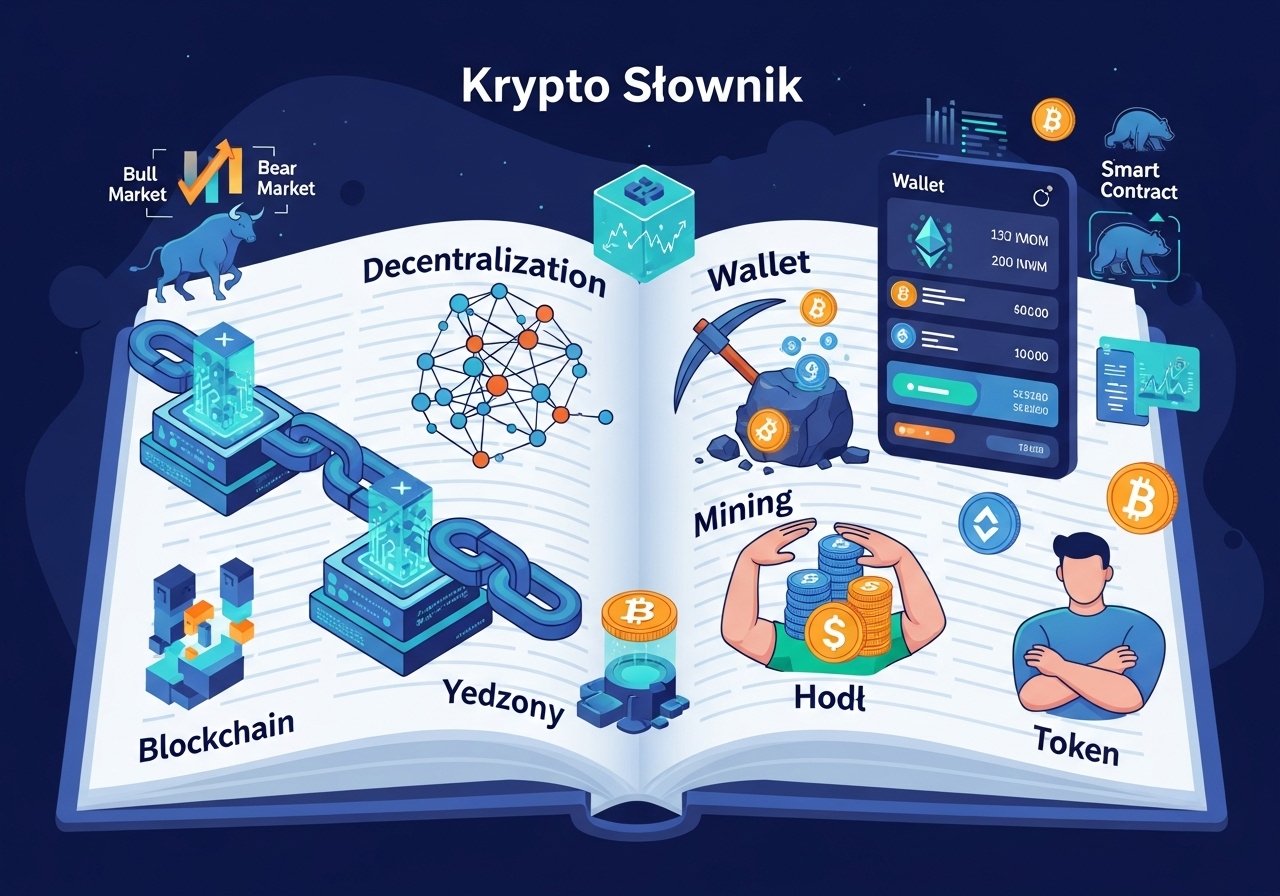
Are you entering the crypto world and feel like everyone around you is speaking a foreign language? "Hodluj", "pump and dump", "to the moon".... Relax! Before you dive into the vortex of speculation and advanced strategies, you need to know the fundamentals. We have prepared for you a complete glossary of basic terms that will open the door to understanding this revolutionary technology. Let's get started! 🚀
Basic concepts
These are the absolute basics, without which you can't move. Think of them as the alphabet of the crypto world.
Blockchain - imagine a digital, decentralized notebook that cannot be forged. That's what blockchain is, a distributed database that stores all transaction information in the form of interconnected blocks.
Cryptocurrency - digital money that uses cryptography (for security) and blockchain technology (to record transactions) to operate. Bitcoin and Ethereum are the most famous examples.
Token - is a digital unit of value created on an existing blockchain. It can represent almost anything: from participation in a project (governance token) to access to a service (utility token).
Wallet - your personal safe in the crypto world. It's an app or physical device that stores your keys and allows you to manage your funds.
Private key - the MOST important element of your wallet. It's a secret string that gives you full access to your cryptocurrencies. Treat it like your bank account password - never share it with anyone!
Public key - think of it as your bank account number. You can share it securely to receive funds. It is linked to your wallet address.
Seed phrase - otherwise known as a "recovery phrase." This is a list of 12 to 24 words that acts as the ultimate backup for your wallet. If you lose your device, this phrase will allow you to regain access to all your funds.
Transactions and networks
How does it all actually work? These concepts explain the mechanics that drive the blockchain world.
Mining (digging) - a process in which powerful computers solve complex mathematical problems to validate transactions and add new blocks to the blockchain. In return, "miners" receive rewards in the form of cryptocurrencies. This is the basis of Proof of Work networks (like Bitcoin).
Staking - a more modern and energy-efficient alternative to digging. It involves "freezing" (locking) your coins to support the security and operation of the network. In return, you receive rewards. This is the heart of the Proof of Stake mechanism (like Ethereum).
Gas fee - a transaction fee you pay for performing operations on the blockchain, such as sending funds or interacting with a smart contract. It is best known from the Ethereum network.
Transaction hash (TxID) - a unique identifier for each transaction, something like a tracking number for a shipment. With it, you can check the status and details of your operation in the public blockchain registry.
Ecosystem
Where to buy, sell and what to trade? Welcome to the crypto ecosystem!
Exchange (exchange) - an online platform that works like a digital currency exchange. This is where you can buy, sell and exchange cryptocurrencies for traditional money (e.g. PLN, USD) or other cryptocurrencies.
DEX (Decentralized Exchange) - a decentralized exchange that operates without intermediaries, directly on the blockchain using smart contracts. It gives users more control over their funds.
Stablecoin - a special type of token, the value of which is rigidly pegged to a traditional currency (most often to the US dollar, e.g. USDT, USDC) or other asset. Its purpose is to minimize price fluctuations.
Altcoin - the name for any cryptocurrency that is not Bitcoin. From Ethereum to smaller, niche projects, they are all altcoins.
DeFi and Web3
The future of finance and the Internet is happening here and now. These concepts are the key to understanding the Web3 revolution.
Smart contract - a self-executing program stored on the blockchain. It works like a digital contract that automatically executes its provisions when certain conditions are met. No lawyers or notaries!
Liquidity pool — a collection of tokens deposited by users on a decentralized exchange. It enables trading without a traditional order book.
Yield farming - an advanced investment strategy in the world of DeFi. It involves moving your funds between different protocols in order to maximize interest earnings and rewards.
DAO (Decentralized Autonomous Organization) - an organization that has no CEO or board of directors. It is democratically managed by its community through smart contracts and tokens.
NFT (Non-Fungible Token) - a unique, non-exchangeable token that represents ownership of a digital (or physical) object - such as a work of art, an item in a game or a concert ticket.
Technical and safety issues
Finally, something for the more inquisitive. Understanding these concepts will help you take better care of your digital assets.
Hashing - a cryptographic process that transforms any amount of data into a unique string of fixed length. This is the foundation of security in blockchain technology.
Consensus mechanism - a set of rules by which all network participants agree on the current state of the network. The most popular are Proof of Work (PoW) and Proof of Stake (PoS).
Layer 1 / Layer 2 - the scaling layers of the blockchain. Layer 1 (L1) is the main network (e.g. Ethereum). Layer 2 (L2) are solutions built "on top" of Layer 1 (e.g. Arbitrum) to increase its speed and reduce transaction costs.
Cold wallet - a hardware wallet (e.g., in the form of a flash drive) that stores your private keys offline, without internet access. This is the most secure form of crypto storage.
Hot wallet — a wallet in the form of a phone or computer app that is constantly connected to the Internet. It is more convenient for daily use, but more vulnerable to hacking attacks.
And that's it! You already have a solid foundation. Remember that the world of crypto is developing at a dizzying pace, but knowing these passwords is your best ticket to entry. Good luck in your further learning! 💡


.jpg)